
By Neil Davis, MuchLoved CEO
One of the most debated - and often misunderstood - topics in online fundraising is how donation platforms charge for their services.
At MuchLoved, we have always been open about our pricing structure. What we haven’t previously done is explain in detail why we decided to keep our flat fee model instead of moving to the tipping model now used by several other well-known platforms.
The reason we have generally avoided going into that level of detail is that it’s a nuanced subject which doesn’t lend itself well to short explanations or soundbites. Instead, we’ve focused on what matters most: ensuring a positive experience for the people using our service and that as much of the total money given by donors as possible reaches charities.
However, because this topic continues to be discussed and debated, we think it’s important to fully explain why the flat fee models gets more money from donors to charities, while simultaneously providing a better donor experience. I’ll try to keep this as clear and straightforward as possible, although some parts will inevitably get quite detailed.
Why do charities use donation platforms?
Processing charitable donations involves real costs and administration. Even when donations are made directly to a charity, there are still payment processing charges, Gift Aid administration requirements, compliance obligations and operational overheads involved in managing those donations responsibly.
This is one of the reasons many charities choose to work with specialist platforms such as MuchLoved. By providing donation processing and in-memory services centrally and at scale across many charities, we are able to deliver these services more efficiently than most charities could reasonably do themselves.
However, while this approach is more efficient, there are still costs involved and every platform has to find a way to cover them. The question is therefore not whether those costs exist, but how they are covered and how transparently that is communicated to donors, charities, funeral professionals, and families.
Understanding the different approaches
There are two main approaches donation platforms use to cover the cost of processing donations: the flat fee model used by MuchLoved and the tipping model now used by several other platforms.
1. The flat fee model
The flat fee model is the original approach and, until relatively recently, almost every donation platform used something broadly similar.
At its core, there are two charges:
a payment provider fee to cover third-party transaction costs; and
an in-house processing fee charged by the platform provider.
MuchLoved has always been transparent about these fees and explains them in detail here:
Transparent Donation Fees and Processing Charges
2. The tipping model
When tipping models were introduced, this was accompanied by the message "no platform fees", which many people understandably interpreted as meaning that all fees had simply been removed and replaced with an optional tip. In reality, it’s not that straightforward.
Although approaches vary, most tipping models still retain:
a payment provider fee at the same level as before (sometimes more); and
a smaller in-house processing fee (usually only applied to the Gift Aid amount rather than the whole donation amount).
The tip is then requested in addition to these existing charges.
In simple terms, while the charges under a tipping model are usually lower than under a flat fee model, they have not disappeared entirely. What was previously called a platform fee is typically removed and replaced with a Gift Aid processing fee, while the payment provider fee remains. As a result, a significant proportion of the original fees remain, even before any tip is taken into account. I'll demonstrate this with a simple example shortly. This is what makes the "no platform fees" claim technically correct, while also helping to explain why it is so often misunderstood.
Thinking about the donor experience
Before comparing the financial outcomes of the two models, it’s important to step back and consider the experience of the people using these services.
A key part of any tipping model is that donors are presented with an additional contribution to support the platform during the donation process itself. Usually, a suggested tip is automatically added by default, requiring the donor to actively reduce or remove it if they do not wish to pay it.
This has a significant impact on the overall donation experience. Declining or reducing the tip often requires additional actions and prompts during what should otherwise be a simple and thoughtful process.
In some fundraising contexts, there may be a reasonable argument that this can encourage donors to contribute more overall. But MuchLoved is different. MuchLoved is a dedicated in-memory platform, and many donations are made at or around the time of a funeral, when people are often in a particularly emotional and vulnerable state.
We do not believe this is the right moment to interrupt donors and ask them for more money. People may not fully understand what is being asked, where the additional money is going, or how the tipping model works. Some may not realise the additional amount is optional or that it can be changed. Others may simply agree because they feel uncomfortable declining, or because they find it too difficult to do so.
Also, if a person is willing and able to contribute more overall, surely the priority should be ensuring that as much of that additional generosity as possible reaches the charity, not the platform?
Our view is that once someone has decided how much they are prepared to give, they should be able to make that donation easily, clearly, and transparently, without additional nudges, surprises or requests for tips during the process.
For us, the flat fee model delivers the best of both worlds: a clearer and more respectful experience for people giving in memory, while also ensuring that more of the total money given by donors reaches charities overall. The important question is why - and the answer becomes clearer once you look more closely at how the different models actually work.
Comparing the models: How the numbers work in practice
Before comparing the numbers directly, it is worth highlighting one reason this topic causes so much confusion. Tipping models are often explained using short, simple statements that sound compelling, but which rely on very precise wording. Small changes in that wording can completely change their meaning.
For example, as discussed earlier, phrases such as “no platform fee” can often be misunderstood to mean there are no fees at all. A similar issue arises with the words “donation” and “money”.
Under the MuchLoved model, the donation is the total amount of money given by the donor. It is straightforward.
Under a tipping model, the total amount of money given by the donor is split into two parts: the donation and the tip.
That distinction matters because it allows a simple statement such as “more of your donation reaches the charity”. That statement may be technically correct and sounds straightforward. The problem is that it is also very easy for it to be misunderstood, misquoted or repeated as “more of your money reaches the charity” — a superficially similar statement, but one with a completely different meaning, and one that is factually incorrect.
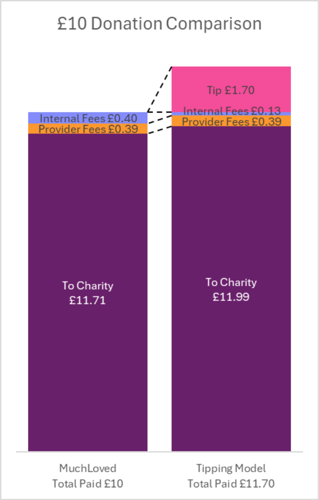
To see why, let’s look at the standard £10 donation example recommended by the Fundraising Regulator and shown on our fees page. Let's assume the donation is eligible for Gift Aid, increasing the total amount available to £12.50, and that under the tipping model the donor chooses to pay the suggested tip of 17%.
Under the MuchLoved model:
the payment provider fee is 39p (1.9% of the £10 donation, plus 20p);
the internal processing fee is 40p (3.2% of the £12.50 amount including Gift Aid; and the charity receives £11.71.
Under a typical tipping model*:
the payment provider fee remains the same at 39p (1.9% of the £10 donation, plus 20p);
the internal processing fee reduces to around 13p (5% on the £2.50 Gift Aid amount); andthe charity receives £11.99.
*Exact fees can vary between platforms. I have used the most common fees published by these platforms - see references for details.
At first glance, this appears to support the argument often made in favour of tipping models. More of the donation reaches the charity - in this example, an additional 28p.
However, in order for the charity to receive that additional 28p, the donor is asked to pay an extra £1.70 as a tip, all of which goes to the platform provider rather than the charity. The net result is that a considerably smaller proportion of the total money given by the donor ultimately reaches the charity.
Earlier, I suggested that if a donor is willing and able to contribute more, the priority should be ensuring that as much of that additional generosity as possible reaches the charity, not the platform.
To illustrate this, a third column has been added to the chart. It shows what would happen if the donor gave exactly the same total amount through MuchLoved as they did in the tipping model example, but directed the additional £1.70 to the charitable donation rather than as a tip to the platform.
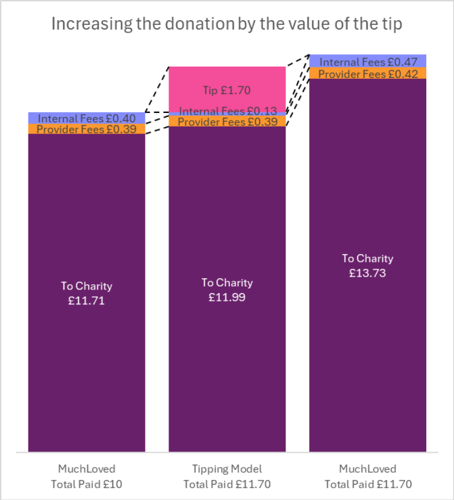
In this scenario, because the additional £1.70 becomes part of the charitable donation itself (and therefore eligible for Gift Aid), the charity not only recovers the earlier 28p difference, but also receives the full benefit of the extra amount, plus a little more.
Overall, the charity receives an additional £2.02, while the total fees increase by only 10p.
This highlights an important distinction that is often overlooked.
The argument in favour of tipping models is often presented as though there are two options: either ask donors for more money through a tip or do not ask for more money at all. In reality, those are two separate questions. The first is whether donors should be asked to contribute more. The second is where that additional money should go.
Technically, MuchLoved could ask donors to increase their donation amount. However, I have already explained why I do not believe this is appropriate during the in-memory donation process. That said, even if you disagree with that view and believe donors should be asked to give more, it does not follow that a tipping model is the best approach.
This example demonstrates why. If a donor is prepared to spend more overall, the charity benefits far more when that additional amount is given as part of the charitable donation than when it is given as a tip to the platform. In other words, even if you believe that donors should be asked for more, the tipping model is still a less effective way of converting that additional generosity into charitable benefit.
Understanding the Effective Cost
At this point, the three scenarios are still difficult to compare directly because the total amounts involved vary between each one. This becomes much clearer when looked at in percentage terms.
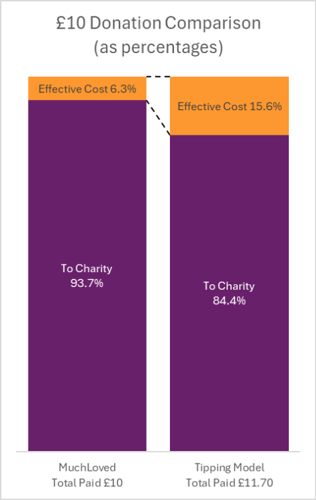
To avoid the confusion caused by separating donations, tips and the various different types of fees, let's instead focus on two simple measures: the total money given by the donor, and the proportion of that money that does not reach the charity, which I refer to as the “Effective Cost”. Ultimately, these are the measures that matter most.
Using the £10 example:
the Effective Cost under the MuchLoved model is 6.3%; and
the Effective Cost under the tipping model is 15.6%.
In other words, a significantly larger proportion of the total money given reaches the charity under the MuchLoved model, as compared to the tipping model.
Looking at the bigger picture
Of course, the £10 example above reflects only one very specific scenario. The Effective Cost varies depending on the donation amount, whether the donation is eligible for Gift Aid, whether a tip is given and, if so, how much of a tip is given.
To understand the broader impact across all donations, we need to make a few assumptions based on real-world usage.
Using MuchLoved platform data, we know:
the average in-memory donation is approximately £45 before Gift Aid;
around 72% of donations are eligible for Gift Aid.
Let's also assume that 70% of donors using a tipping model platform leave a tip, based on figures publicly cited by services using that model. For those who do tip, I will assume they pay the suggested amount, which is typically around 17%. This seems a reasonable assumption, given suggested tip levels are generally presented as the normal or recommended option during the donation process.
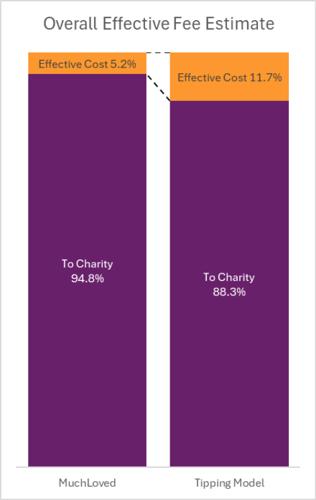
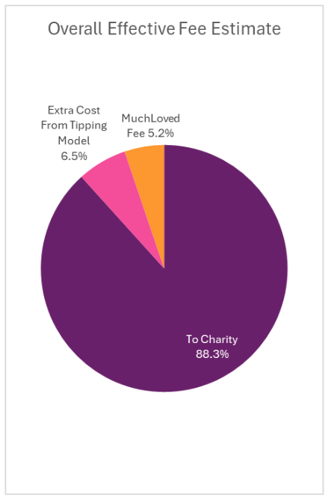
Applying these assumptions results in an overall estimated Effective Cost across all donations of approximately 11.7% under the tipping model, compared to 5.2% under the MuchLoved flat fee model.
In other words, across broader real-world donation patterns, including where people choose to remove the tip, the tipping model approach continues to result in an overall Effective Cost more than twice that of the MuchLoved model.
This aligns with the publicly reported results of platforms that have adopted tipping models, several of which have reported significantly increased profits after moving away from flat fee structures.
What if our assumptions are wrong?
A reasonable question at this point is: what happens if our assumptions about tipping are wrong? What if average tip amounts are lower? What if fewer people tip? (Or more?)
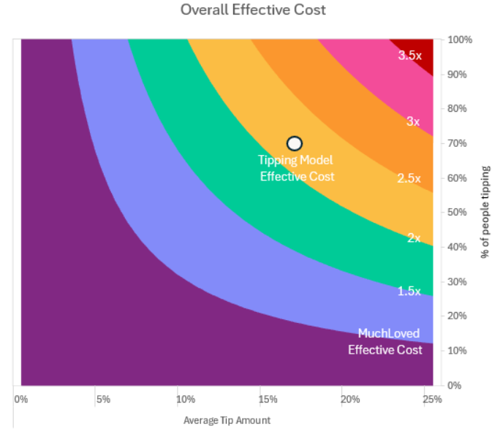
The chart above helps visualise this. By referencing an average tip amount with the estimated percentage of people tipping, you can use the colour bands to understand the approximate Effective Cost. As an example, I have marked on the chart where the tipping model sits, based on our assumptions of 17% and 70% respectively.
The purple curve represents the level of tipping which would result in a Effective Cost equivalent to the MuchLoved Effective Cost. The coloured curves then show multiples of that cost — 1.5x, 2x, 2.5x and so on.
What this chart demonstrates, is that the tipping model Effective Cost is not marginally higher than the MuchLoved model - it is substantially higher across all realistic scenarios. For the tipping model to benefit charities overall, either tipping rates or average tip amounts would need to be significantly lower than the figures publicly suggested by providers using these models. Yet some platforms report that up to 80% of donors leave a tip, while suggested tip amounts commonly range from 18% to 25%.
To determine a truly accurate comparison, the platforms operating tipping models would need to publish their actual figures: the proportion of donors who leave a tip, and the average tip amount among those who do. We would welcome greater transparency across the sector regarding this data.
Isn’t it still better to give people the choice?
Some people may reasonably ask: even if the overall Effective Cost is higher, isn’t it still better to let donors decide whether or not they want to leave a tip?
On the surface, there is an understandable argument for that. If an individual donor chooses not to leave a tip, then more of their own donation will reach the charity than under a flat fee model.
However, that only works when viewed at the level of a single donation.
The tipping model itself depends on the fact that a significant majority of donors leave tips. Without that, the model would not generate sufficient income for providers to operate sustainably.
So while an individual donor may feel they are benefiting the charity by declining to tip, the overall result across all donors is still that a larger proportion of the total money given ends up being retained by the platform provider rather than reaching charities.
Ultimately, I believe the most important question is not whether one individual donation reaches the charity more efficiently, but whether charities receive more overall. That is why I have looked not only at individual donation examples, but also at the wider impact of these models across all donations. Looking only at isolated scenarios where an individual does or does not leave a tip risks misrepresenting the overall picture.
If so many platforms have moved to tipping models, why hasn’t MuchLoved?
MuchLoved was founded to help people remember and cherish the lives of those they love. Our founder from over 20 years ago remains our Chair and a Trustee of the MuchLoved Charitable Trust, and the values the platform was built on remain unchanged.
Our responsibility is to provide the best possible experience for the families, donors, funeral directors and wider community who rely on our service, while ensuring that charities receive the greatest possible benefit from donations made through our platform.
We do not believe that asking for tips during the in-memory donation process is appropriate. Equally, our fees are set at a level designed to enable us to operate and develop the service responsibly, not to maximise revenue. We do not have external investors seeking financial returns and we are not under pressure to optimise for profit margins.
For a number of years there has been significant pressure across the sector - including on MuchLoved - to move towards tipping models, largely because many people understandably believed they were automatically “free” or better for charities. However, as understanding of how these models actually work has increased, that conversation has started to shift. Tipping models are now receiving increasing scrutiny from the media, regulators, and politicians, particularly around transparency and the overall amounts ultimately retained by platforms.
In closing
I appreciate that this is a complex and often misunderstood topic, which is precisely why I wanted to explain our reasoning openly and transparently. If you have questions about any aspect of the figures, assumptions or calculations discussed in this article, I would be very happy to discuss them further.
Ultimately, at MuchLoved, we believe our model delivers the best of both worlds: a clearer and more respectful experience for people giving in memory, while also ensuring that more of the total money given by donors reaches charities.
I hope this article has helped explain the reasoning behind our approach and contributes to a more open and transparent discussion across the sector about how donation platforms operate.
References and further reading:
The Psychology of Tipping on Fundraising Platforms | How Voluntary Tips Work | Emma - provides a good summary of default tipping amounts on some of the larger platforms and how the tipping model leads to a poor experience for donors.
JustGiving Fees Explained - Understand Our Donation & Fundraising Costs - JustGiving fees pages
Pricing and Fees - GoFundMe (UK) - GoFundMe fees page
Pricing - Enthuse: Branded fundraising for charities - Enthuse fees page
Enthuse voluntary gift | Enthuse Help Centre - Page indicating how many donors leave a tip.
JustGiving’s website not fully compliant with fundraising code, regulator warns | Third Sector - Includes information on fees, increased profits and regulatory scrutiny.
Fundraising Regulator opens investigation into JustGiving | LinkedIn - LinkedIn post sharing The Times article